2025
·
Studio Sprint
·
Furniture

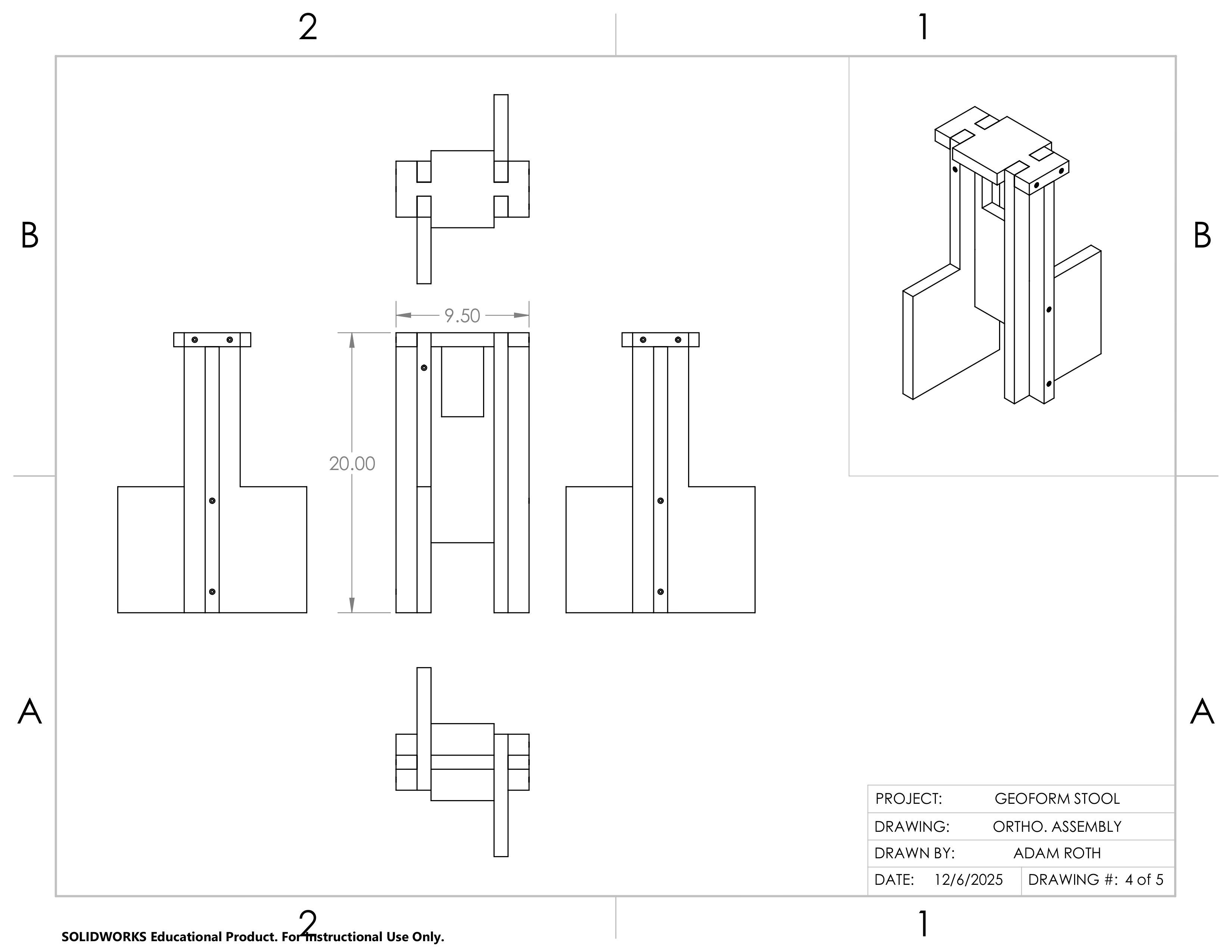
This project resembled a tightly constrained engineering puzzle: a functional seat had to be realized from a single length of poplar, composed of exactly four planar components with faces perpendicular to one another and no pierced cuts. Every cut, joint, and grain orientation required advance planning because the piece would be fabricated strictly from SolidWorks drawings treated as production contracts. Fabrication realities like a table saw, band saw, jointer, planer, router, and drill press all shaped design decisions as much as ergonomics and compositional hierarchy did.
01 — Research & Development
Early foam-core models and shop trials tested proportion, balance, and assembly. Attempts to maximize height exposed the limits of the available board widths, producing an unstable form and forcing a reconsideration of scale and center of gravity.
These iterations established a direction where structural performance, visual hierarchy, and ergonomics could be resolved through a concise four-part system.
02 — Fabrication & Structural Logic
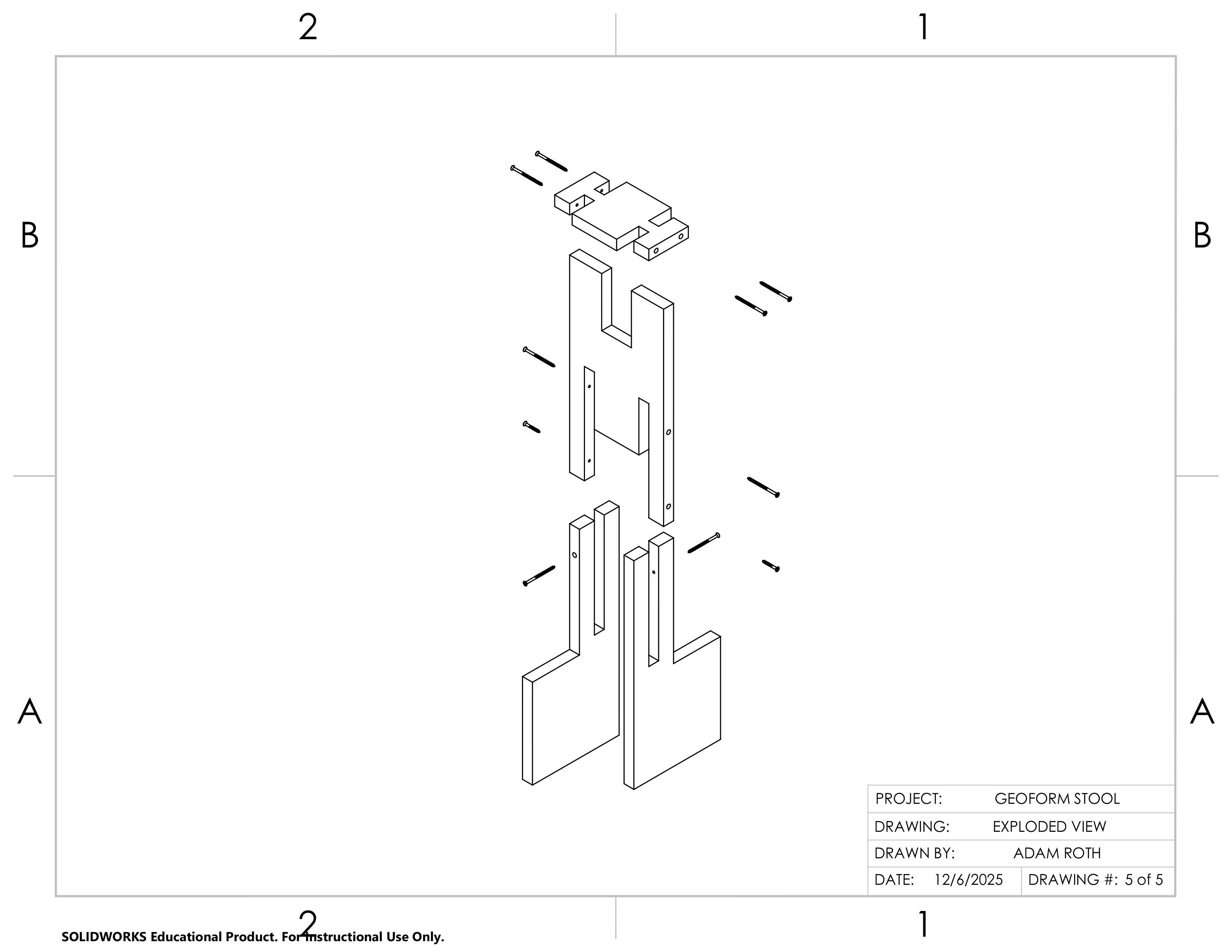
The final stool uses the full capacity of each board: 20-inch runs, one-inch thicknesses, and broad mating faces that distribute weight across multiple members. Long grain carries compression through the seat, while stacked perpendicular planes resist shear. Interlocking geometry and tight tolerances allow the four elements to share load without relying on a single fastener.
Fabricated with standard woodworking tools (including a table saw, band saw, jointer, planer, router, and drill press) the piece translates precise digital drawings into a functional object. Each fabrication decision reinforces the structural system, turning four simple planar parts into a stable seat.

The completed stool is a materially efficient, structurally honest response to a highly restrictive brief. Its solid planes and intentional voids shift in elevation, revealing alternating intersections and seemingly floating surfaces as the viewer moves around it. Calibrated to support a comfortable seated posture, the form balances human use with compositional clarity. Every aesthetic decision also serves the structure, resulting in a seat that treats material limits and fabrication constraints as defining features of the design.
